
Disclaimer: This page is intended for healthcare professionals only.
GOALS OF TREATMENT
The goals of cystitis treatment are to:

Eradicate the infection1,2

Prevent
recurrent
infection1,3

Provide symptomatic
relief in
acute infection1-3

Prevent complications
of untreated acute infection1-3
To ensure patient-centric care, it is best practice to confirm the patient’s goal(s) of treatment.
NONPHARMACOLOGICAL AND
PHARMACOLOGICAL TREATMENT
Consider the following nonpharmacological options for treatment and prevention

NONPHARMACOLOGICAL TREATMENT
- Application of heating pad to the abdomen or back to help ease discomfort4
- Warm/hot sitz baths to relieve discomfort5
- Avoiding any food or beverages suspected to make symptoms worse or irritate the bladder (e.g., caffeinated drinks)4

NONPHARMACOLOGICAL PREVENTION STRATEGIES
- Increase daily water intake6
- Avoid use of spermicides if sexually active, since they are associated with increased risk of UTI (use alternative methods of contraception)1,3,7
- Frequent and complete voiding2
The following are not proven to reduce UTIs but can be recommended:
- Early post-coital voiding1,7
- Wiping from front to back after urination1,7
Other preventative strategies that may be considered include avoiding using chemical irritants, (e.g., spermicidal jellies, feminine hygiene sprays, and some bath products), and to opt for wearing cotton underwear4
PHARMACOLOGICAL STRATEGIES
There are pharmacological approaches to address acute uncomplicated cystitis and its effects. These include antibiotics for treatment of the infection, over-the-counter (OTC) products for treatment or symptom relief, and OTC products to prevent further infections.3,7-9
ANTIBIOTICS FOR TREATMENT OF UNDERLYING INFECTION
Treatment with antibiotics is the standard of care for patients with acute uncomplicated cystitis and severe symptoms. However, all symptomatic patients should be offered antimicrobial therapy irrespective of the intensity of their symptoms.3
Acute uncomplicated cystitis is a self-limiting condition and typically will resolve without treatment.7 In fact, within 7 days, half of patients presenting with symptomatic acute uncomplicated UTI may become symptom-free without antibiotics.3 However, antibiotic treatment reduces the duration of symptoms and decreases the risk of progression to pyelonephritis.7
When compared with ibuprofen treatment, antibiotic treatment reduces the symptom burden in a higher proportion of patients, shortens the duration of symptoms and improves activity scores.3 However, NSAID monotherapy has been associated with a greater incidence of complications than NSAID + antibiotic combination therapy (e.g., pyelonephritis).3,7
Review the following antibiotic options for treatment of acute, uncomplicated cystitis at a glance, including their dosing, efficacy and safety profiles:
Select Antibiotics1,7
- Nitrofurantoin monohydrate/ macrocrystals
- Sulfamethoxazole-trimethoprim
- Fosfomycin tromethamine
- Trimethoprim
-


DOSAGE1,7
100mg BID†‡ x 5 days
-


EFFICACY1,7
- First line for empiric therapy
- Clinical efficacy: 84-95%
- Low to minimal resistance; retained excellent susceptilibity
- Worked well for previous infection
-


SAFETY1,7
- Contraindicated in patients with a CrCl* 30 ml/min
- Common side effects may include headache, nausea, urine discoloration, gas/bloating, oral/vaginal candidiasis
-


DOSAGE1,7
800mg/ 160mg BID†‡ x 3 days
-


EFFICACY1,7
- Second line for empiric therapy
- Clinical efficacy: 79-100%
- Resistance can be a concern
-


SAFETY1,7
- Ask about sulfa allergy, may cause kidney stones (rare – maintain hydration)
- Common side effects include rash, urticaria, nausea, vomiting, oral/ vaginal candidiasis
-


DOSAGE1,7
3g dissolved in ½ cup cold water OD‡ × 1 day
Take on empty stomach or at least 2-3 hours after a meal
-


EFFICACY1,7
- Third line
- Clinical efficacy: up to 91%
- Resistance rare
-


SAFETY1,7
- Generally good
- Common side effects may include diarrhea, headache, nausea, oral/ vaginal candidiasis
-


DOSAGE1,7
100mg BID‡ x 3 days OR 200mg OD‡ x 3 days
-


EFFICACY1,7
- Resistance can be a concern
- Option if allergy to sulfonamides
-


SAFETY1,7
- Generally good
- May cause kidney stones (rare – maintain hydration)
Have a closer look at the options
- Nitrofurantoin monohydrate/macrocrystals is dosed twice daily and may be better tolerated than the standard macrocrystal formulation3
- Nitrofurantoin is not recommended for treatment of pyelonephritis3
- Nitrofurantoin for 5 days is as effective as sulfamethoxazole-trimethoprim for 3 days in the treatment of acute uncomplicated UTI3
- It is recommended that the use of sulfamethoxazole-trimethoprim be avoided if local resistance is > 20% or if it was used for UTI in the previous 3 months7
- Instruct patients to dissolve the fosfomycin sachet contents in ½ cup of cold water, stir the solution and ingest immediately7
- Although fosfomycin may be potentially less effective than nitrofurantoin, sulfamethoxazole-trimethoprim or fluoroquinolones, a single 3g dose is recommended as first-line treatment of acute uncomplicated UTI1,3
- Fosfomycin does not show cross-resistance with other antibiotics. Thus, most community-acquired bacterial strains may be susceptible3
 Keep in mind:
|
Local resistance patterns must be considered when choosing empiric antibiotic therapy.7 Check local resistance rates through your public health unit, keeping in mind that local resistance profiles may be skewed to complicated cases because uncomplicated UTIs are not typically cultured. 1,7 Sulfamethoxazole-trimethoprim may be a treatment option where local E. coli resistance rates are <20%.1
OTC treatment
D-mannose has been shown to be a potential OTC treatment for UTIs.
D-Mannose Supplements
- Post hoc analysis found that use as monotherapy achieved cure rates similar to antibiotics10
- Symptom relief after 3 days was comparable to antibiotics10
- May be a safe and effective alternative but further randomized, controlled trials with a relevant number of patients are needed10
OTC pain management
Consider the following to support symptomatic relief:
OTC analgesics
- OTC analgesics such as acetaminophen, or ibuprofen, etc. may be used for pain relief7
- Nonsteroidal anti-inflammatory drugs (NSAIDs) such as ibuprofen should not be used without antibiotics6 because NSAID monotherapy s versus antibiotics has been associated with a greater incidence of complications (e.g., pyelonephritis)3,7
Important: NSAID monotherapy should not be considered for the treatment of acute uncomplicated cystitis.3
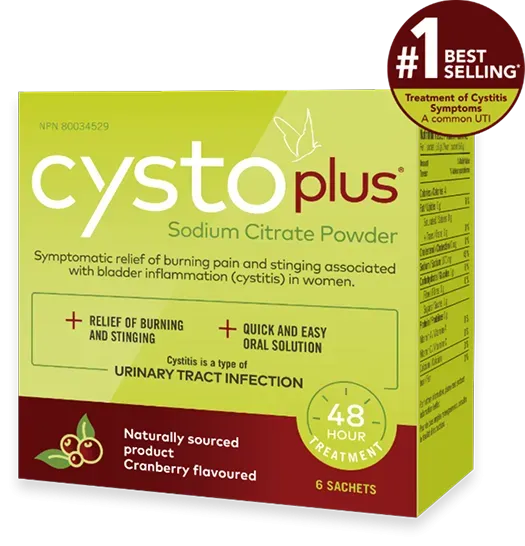
Cystoplus® Sodium Citrate Powder
- For the symptomatic relief of burning and stinging associated with cystitis in adult women8
- Available without a prescription in pharmacy.
- Natural health product
OTC prevention overview
Consider the following:
Cranberry juice
- Conflicting evidence from clinical trials3
- No single concentration has been studied making it difficult to choose a cranberry juice over another9
- Benefit in prevention for females small9
- Some evidence to support use in the prevention and treatment of UTIs (moderate to low certainty§)11
- Preventive use may be expensive9
Cranberry supplements
- Conflicting evidence from clinical trials3
- No single concentration has been studied making it difficult to choose one cranberry supplement over another9
- Benefit to prevent recurrent UTIs in females small9
- Preventive use may be expensive9
D-Mannose Supplements
- D-mannose prophylaxis significantly reduced UTI recurrence (4.5% vs. 33.3%) and delayed onset (43 vs. 28 days) compared to no prophylaxis in a pilot study of women post-UTI12
While cranberry products have been widely used to prevent UTI, the evidence from clinical trials is conflicting. Thus, cranberry juice, powder or tablets should not be recommended for UTI prevention.3 If your patient wishes to drink cranberry juice to prevent UTIs, advise them to drink pure, unsweetened cranberry juice (rather than cranberry juice cocktail).9 It should also be noted that there is no evidence to support the use of probiotic products (e.g., products containing Lactobacillus species) to prevent or treat UTI.3 Consuming D-mannose may prevent bacteria from adhering to the lining of the urinary tract. D-mannose may be a safe and effective alternative to antibiotics in the treatment of acute uncomplicated cystitis. However, further randomized, controlled trials including a relevant number of patients are needed in order to confirm the beneficial effect of D‑mannose.10
The role of Cystoplus®
Holistic, patient-centric care means addressing both the infection and the associated pain when managing cystitis.
While you focus treatment on the underlying cause of acute uncomplicated cystitis, Cystoplus® can be a valuable addition to your cystitis practice for symptomatic relief.
If you are unsure what to suggest to provide symptomatic relief while UTI treatment with antibiotics takes effect, consider recommending Cystoplus®, a convenient 48-hour course of symptomatic treatment.**
*Nielsen sales data, unit volume, Canada, L52W ending May 16, 2026.
- *CrCL: Creatinine clearance
- †OD indicates once daily
- ‡BID indicates twice daily
- §A systematic review and network meta-analysis of 20 studies found there was some evidence to support the use of cranberry juice for the prevention and treatment of UTIs. However, the evidence sits at moderate to low certainty, highlighting the need for additional RCTs.11 RCT= randomised controlled trials
References:
- Canadian Pharmacists Association (CPhA). How can you help your patients with an uncomplicated UTI? April 2021. Available at: https://www.pharmacists.ca/cpha-ca/assets/File/education-practice-resources/Uncomplicated_UTI.pdf. Accessed June 9, 2025.
- Brusch JL, Bavaro MF, Tessier JM et al. Urinary tract infection (UTI) and cystitis (bladder infection) in females. Updated January 02, 2025. Available at: https://emedicine.medscape.com/article/233101-overview . Accessed June 10, 2025.
- Nicolle L. CPS. Urinary tract infection. Revised September 28, 202. Available at: https://cps.pharmacists.ca/print/new/documents/CHAPTER/en/urinary_tract_infection . [Subscription required] Accessed June 10, 2025.
- Healthline. What Is cystitis? Updated April 16, 2019. Available at: https://www.healthline.com/health/cystitis . Accessed June 9, 2025.
- Yale Medicine. Cystitis. Available at: https://www.yalemedicine.org/conditions/cystitis . Accessed June 9, 2025.
- Hooton TM, Vecchio M, Iroz A, et al. Effect of Increased Daily Water Intake in Premenopausal Women With Recurrent Urinary Tract Infections: A Randomized Clinical Trial. JAMA Intern Med. 2018;178(11):1509-1515. doi:10.1001/jamainternmed.2018.4204
- medSask. University of Saskatchewan. Guidelines for prescribing for minor ailments and patient self-care: Cystitis - acute, uncomplicated. Available at: https://medsask.usask.ca/professional-practice/restricted-guidelines/other-provinces/urinary-tract-infection-cystitis---acute%2C-uncomplicated.php . [Subscription required] Accessed June 10, 2025.
- Health Canada. Cystoplus Sodium Citrate Powder Product Licence. Issued, August 10, 2012.
- Government of Alberta. MyHealth.Alberta.ca. Cranberry juice and urinary tract infections. April 30, 2024. Available at: https://myhealth.alberta.ca/Health/pages/conditions.aspx?hwid=hw55783 . Accessed June 11, 2025.
- Wagenlehner F, Horst Lorenz H, Ewald O et al. Why d-mannose may be as efficient as antibiotics in the treatment of acute uncomplicated lower urinary tract infections—preliminary considerations and conclusions from a non-interventional study? Antibiotics (Basel). 2022;11(3):314. doi: 10.3390/antibiotics11030314 .
- Moro C, Phelps C, Veer V et al. Cranberry juice, cranberry tablets, or liquid therapies for urinary tract infection: a systematic review and network meta-analysis. Eur Urol Focus. 2024;10(6):947–957. doi: 10.1016/j.euf.2024.07.002 .
- Domenici L, Monti M, Bracchi C, et al. D-mannose: a promising support for acute urinary tract infections in women. A pilot study. Eur Rev Med Pharmacol Sci. 2016;20(13):2920-2925.
Disclaimers
- Cystoplus® is recommended for symptomatic relief of burning and stinging associated with cystitis in adult women.8
- If patients have more than just mild symptoms (for example: painful urination, blood in urine or side pain, fever and chills, nausea and vomiting), or if symptoms persist or return soon after completing the 48-hour treatment, they should consult their health care practitioner. Cystoplus® is contraindicated in individuals taking lithium or hexamine, are on a low-sodium diet, are sensitive to any of the ingredients, if they are pregnant or breastfeeding, and in men and children.8
- **Although Cystoplus® Sodium Citrate Powder is not contraindicated for use with antibiotics, patients should always inform their primary care provider if they are taking any other medication. Due to its alkalizing effect on urine, sodium citrate can affect the excretion of certain antibiotics and alter their pharmacokinetic profiles.
- Always direct the patient to read the label.
- For more information: See Warnings, Cautions, and Directions of Use at https://health-products.canada.ca/lnhpd-bdpsnh/info?licence=80034529 for information to assist in benefit-risk assessment. The terms of Market Authorization are also available upon request by calling us at 1-888-550-6060.
