
Disclaimer: This page is intended for healthcare professionals only.
WHAT IS CYSTITIS?
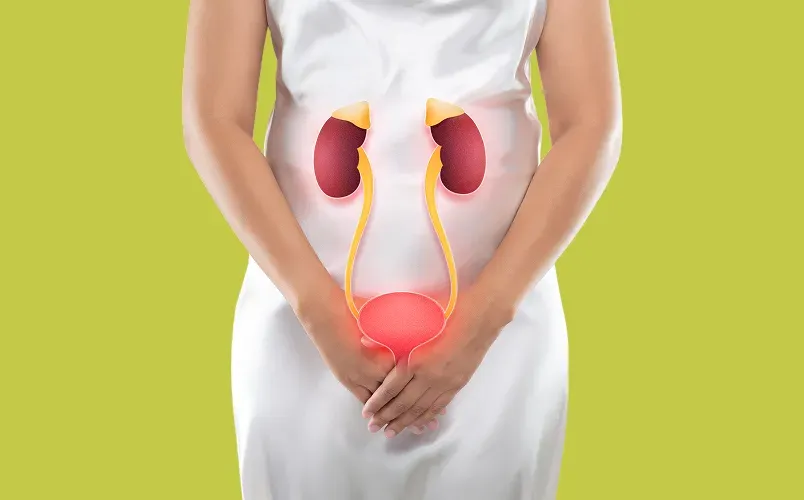
Cystitis is inflammation of the bladder and, in most cases, is caused by bacteria.1 When bacteria is the cause, cystitis may be known as a urinary tract infection (UTI) or lower UTI.1,2
Cystitis is a common condition.1 However, while it can affect anyone, cystitis occurs more often in females than males.1,3 In fact, it is estimated that approximately 60% of females will experience symptomatic acute bacterial cystitis in their lifetime.2 Females are particularly susceptible to cystitis due to the proximity of the rectum to the external opening of the urethra, as well as the relatively short urethral length in females.4 In an individual with a penis, the urethra is about 20 cm long versus about 3-4 cm long in an individual with a vagina.5
Bacteria are frequently found in and around the anus and the vagina.1 Given the urethra is short and located close to both openings in females, there is an increased risk of bacteria from the anus or vagina entering the urethra and reaching the bladder.1,5
CYSTITIS CAN BE BROADLY CLASSIFIED
AS EITHER UNCOMPLICATED OR COMPLICATED.4
UNCOMPLICATED CYSTITIS
Uncomplicated cystitis refers to a lower UTI in non-pregnant women who are otherwise healthy.4 The medSask Guidelines for Prescribing for Minor Ailments and Patient Self-Care for Cystitis – Acute, Uncomplicated define an uncomplicated UTI as "a urinary tract infection, which has not extended beyond the bladder, caused by the usual pathogens in a patient with a normal urinary tract.”7
COMPLICATED CYSTITIS
Complicated cystitis is associated with risk factors that increase either the likelihood and risk of the infection or the chances of failing antibiotic therapy.4 The medSask guidelines define a complicated UTI as “a urinary tract infection in a patient with risk factors for a severe infection or sequelae or factors which have not traditionally been included in the clinical trials evaluating antibiotic therapy.”7

About 60% of females will experience symptomatic acute bacterial cystitis in their lifetime2
Etiology
Get to know the most common causes for each classification of infectious cystitis.

Acute uncomplicated cystitis
- Escherichia coli (75% to 95% of cases)4,7
- Staphylococcus saprophyticus (5% to 10% of cases)4,8
- Klebsiella pneumoniae4
- Proteus mirabilis4
Complicated cystitis
- Escherichia coli (most common cause)4
- Enterobacter4
- Citrobacter4
- Serratia4
- Pseudomonas4
- Enterococci4
- Staphylococci4
Risk factors:
Several factors increase the risk of cystitis in individuals. These are outlined below for females and males

Females
- Recent sexual intercourse1,7.
- Use of spermicide or diaphragms as birth control1,3,7.
- History of urinary tract infections (UTIs)1.
- Vaginal atrophy in postmenopausal patients1,7.
- Pregnancy1.
- Urinary or fecal incontinence1.
- Prolapsed bladder wall (cystocele)1.
- Use of irritating personal hygiene products3.

Males
- Uncircumcised: Remaining uncircumcised increases the risk of cystitis because the foreskin creates a moist environment where bacteria may become trapped near the end of the urethra1.
- Insertive anal sex: Males who engage in insertive anal sex increase their cystitis risk because it exposes the end of their urethra to fecal matter1.
- Enlarged prostate or other anatomical blockage of the bladder1,3.

Additional risk factors for both sexes
- Structural or functional urinary tract abnormalities (e.g., catheter, neurogenic bladder, kidney stones)1,3,7.
- Some medications (e.g., sodium-glucose co-transporter 2 [SGLT2] inhibitors)7.
- Radiation3.
- Medical conditions (e.g., poorly controlled diabetes, spinal cord injuries, multiple sclerosis, Parkinson’s disease); these conditions can lead to inadequate bladder control by affecting the brain, nerve, or spinal cord1,3,7.
- Kidney stones or history of kidney stones3.
- Being in an immunocompromised state, either disease- or drug-induced7.
 Keep in mind:
Cystitis is not always due to a bacterial infection. While some of the risk factors discussed can increase the risk of infection, others, such as some medications and personal hygiene products, can cause bladder inflammation without infection.3
Recognizing the signs and symptoms

The primary signs and symptoms of acute uncomplicated cystitis are6,7,8
- Internal dysuria (burning sensation on the interior of the urethra during urination); note that a burning sensation on the exterior may be more consistent with vaginitis.
- Urinary urgency.
- Urinary frequency.

Patients may also experience6,7
- Suprapubic pain.
- Mild hematuria (blood in the urine).
- Foul-smelling or cloudy urine (not an indicator of bacterial infection on its own).
Keep in mind:
There is an absence of vaginal discharge with acute uncomplicated cystitis.6,7 Also, signs and symptoms may be subtle or atypical in the very young or elderly (e.g., poor feeding, confusion, delirium, agitation/irritability). These patients should be referred and not treated as part of a minor ailment program.1,7
The signs and symptoms not characteristic of acute uncomplicated cystitis but rather indicative of complicated cystitis include6,7
- Systemic signs and symptoms (e.g., fever, chills, nausea and/or vomiting)
- Flank or back pain (pain in the side or back below the ribs)
- Significant malaise
- Vaginal discharge or pruritus
- Dyspareunia
- Significant hematuria
Knowing when to refer
Most patients with typical signs and symptoms of acute uncomplicated cystitis do not require further investigation.7 However, there are “red flags” that warrant referral to the patient’s primary care provider for assessment.6,7
Get to know the "red flags"
- The patient is male6,7
- Changes to the urinary tract with gender-affirming surgery7
- < 16 years of age or > 75 years of age6,7
- No previous diagnosis of cystitis by a physician6,7
- Previous episode of UTI within last 4 weeks6,7
- Consider referral if recurrence: ≥ 2 uncomplicated UTIs in 6 months or ≥ 3 uncomplicated UTIs in 12 months (may still prescribe for the current episode)6,7
- History of interstitial cystitis6,7
- Immunocompromised due to disease state or drug induced (e.g., allopurinol, danazol)6,7
- Living in long-term care6,7
- Pregnancy6,7
- Breastfeeding/chestfeeding and infant < 1 month6,7
- Uncontrolled diabetes6,7
- Abnormal urinary tract function or structure6,7
- Recent urinary tract procedure or surgery7
- Renal impairment (CrCl* <60 mL/min6,7
- Spinal cord injury6,7
References:
- Yale Medicine. Cystitis. Available at: https://www.yalemedicine.org/conditions/cystitis . Accessed June 9, 2025.
- Anger J, Lee U, Ackerman AL et al. Recurrent uncomplicated urinary tract infections in women: AUA/CUA/SUFU guideline. J Urol. 2019;202(2):282–9. doi: 10.1097/JU.0000000000000296
- Healthline. What Is cystitis? Updated April 16, 2019. Available at: https://www.healthline.com/health/cystitis . Accessed June 9, 2025.
- Li R, Leslie SW. In: StatPearls [Internet]. Cystitis. Updated May 30, 2023. Available at: https://www.ncbi.nlm.nih.gov/books/NBK482435/ . Accessed June 9, 2025.
- Canadian Pharmacists Association (CPhA). UTI - uncomplicated or complicated? Available at: https://www.pharmacists.ca/cpha-ca/assets/File/Infographic/uti_infographic_en.pdf . Accessed June 9, 2025.
- Canadian Pharmacists Association (CPhA). How can you help your patients with an uncomplicated UTI? April 2021. Available at: https://www.pharmacists.ca/cpha-ca/assets/File/education-practice-resources/Uncomplicated_UTI.pdf . Accessed June 9, 2025.
- medSask. University of Saskatchewan. Guidelines for prescribing for minor ailments and patient self-care: Cystitis - acute, uncomplicated. Available at: https://medsask.usask.ca/professional-practice/restricted-guidelines/other-provinces/urinary-tract-infection-cystitis---acute%2C-uncomplicated.php . [Subscription required] Accessed June 10, 2025.
- Nicolle L. CPS. Urinary tract infection. Revised September 28, 202. Available at: https://cps.pharmacists.ca/print/new/documents/CHAPTER/en/urinary_tract_infection . [Subscription required] Accessed June 10, 2025.
- Health Canada. Cystoplus® Sodium Citrate Powder Product Licence. Issued, August 10, 2012.
Disclaimers
- Cystoplus® is recommended for symptomatic relief of burning and stinging associated with cystitis in adult women.9
- If patients have more than just mild symptoms (for example: painful urination, blood in urine or side pain, fever and chills, nausea and vomiting), or if symptoms persist or return soon after completing the 48-hour treatment, they should consult their health care practitioner. Cystoplus® is contraindicated in individuals taking lithium or hexamine, are on a low-sodium diet, are sensitive to any ingredients, if they are pregnant or breastfeeding, and in men and children.9
- Always direct the patient to read the label.
- For more information: See Warnings, Cautions, and Directions of Use at https://health-products.canada.ca/lnhpd-bdpsnh/info?licence=80034529 for information to assist in benefit-risk assessment. The terms of Market Authorization are also available upon request by calling 1-888-550-6060.
